

Where better to begin a boat trip than in the Waterstraat? Here, at Kasteelhoeve De Grote Hegge in Thorn, a gathering takes place on Thursday 15 March for around sixty MyDrives consultants from all directions. Marc Stijfs, together with Jos Crijns the founder of MyDrives, MyHabits and MyMatch, talks about the British Men's Rowing Eight. This rowing crew took a disappointing seventh place in rowing's blue riband event at the 1998 World Championships in Cologne.
Will it make the boat go faster?
A new coach arrives. He takes stock of the crew and then informs the rowers of his findings: ’Every one of you is a top rower. You have a top support staff guiding you and you have the very best equipment. So all of that is in excellent order. But we are going to change one thing if we want to take gold at the Olympic Games in Sydney in 2000. From now on we ask ourselves this question about everything we do: will it make the boat go faster? A wild party the evening before a training session will not, an extra Sunday morning session on the Thames will. And so on.’
Gold medal
How did the story end? Two years later, in Sydney, the British rowing crew did indeed take the gold medal. That was, incidentally, the first British victory in the eight at the Summer Olympics since 1912. Marc Stijfs asks the MyDrives consultants present whether the rowers' victory might have had more to do with the best lane or with weak opposition. Another possibility: the British simply got lucky. He gives the answer himself: the entire mindset of the gold-winning crew changed over two years. He adds that his own mindset and that of Jos Crijns is continuously aimed at helping MyDrives consultants make their boat go faster. Whether that boat is called MyDrives, MyHabits or MyMatch.
MyMatch, MyDrives and MyHabits in one triangle
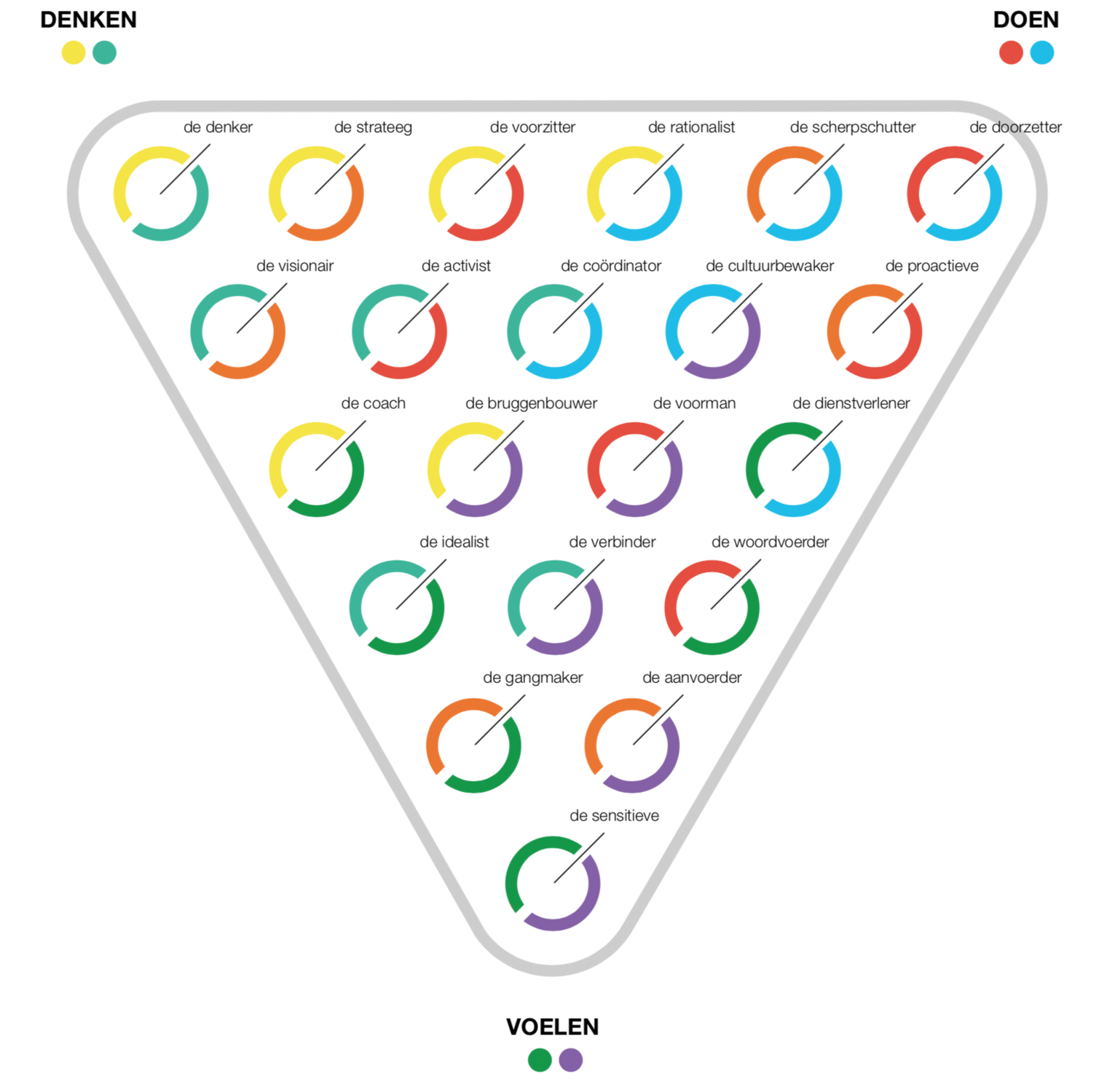
That happens first of all through the introduction of a new triangle based on the key words thinking, feeling and doing. This triangle has been carried over from MyMatch into the MyDrives analysis. As a result it becomes even clearer, even faster, which preferred roles suit an applicant and to what extent their drivers correspond with the drivers linked to the role they want to be considered for. At the same time this versatile triangle proves its value for MyHabits, because it offers the possibility of observing and measuring the behaviour of an employee, for instance. On that basis, 360⁰ feedback can take place to fine-tune their role within the organisation.
New MyMatch booklet
The introduction of the triangle has also led to a new MyMatch booklet. As for MyDrives: the explanation of the stress pattern has been developed further, among other things by adding tips that show how best to use your ’pause button’ in a hectic situation. In addition a new chapter has been added about preferred roles in the MyDrives analysis. During the interactive part of the gathering, Marc Stijfs and Jos Crijns use www.menti.com. In combination with a special code, this website allows those present to take part live and anonymously, via their mobile phones, in answering questions about the various drivers.
Ben Hunt-Davis
And so this gathering too contributes to MyDrives consultants building on their self-knowledge and their knowledge of other people in order to be successful in their work. On that note: Marc Stijfs's rowing story is based on the management book Will it make the boat go faster? It was co-written by Ben Hunt-Davis, one of the rowers who won gold at the Olympic Games in Sydney. From a review, for anyone who still has room on their bedside table: The book is an authentic account of a journey to success that will show you how you can succeed in whatever you want to do.
Rather experience for yourself what drives you?
Take the free miniscan and discover in a few minutes what moves you.
More blog articles
Do not get caught by the cobra effect
24 October 2017

A mismatch affects both employee and employer
21 September 2017
Team-building session via colour analysis: 7 common mistakes
29 August 2017