
Since the beginning of the last century, countless models have been developed to help us understand people's behaviour better. Some well-known models:
· The Big Five is a theory based on five personality characteristics or traits that are ’normally’ distributed. This means that you do not have to be either introverted or extraverted, but that your personal score usually lies somewhere in between.
· The Myers-Briggs Type Indicator, or MBTI, gives insight into how people experience the world and make decisions. MBTI uses four of the Big Five characteristics and does not work with a normal distribution. Here you are either introverted or extraverted.
· The enneagram describes nine types of people who differ from one another in their thinking, feeling and doing.
· Core qualities is a method that makes people's core qualities, pitfalls, challenges and allergies visible.
· The Leary Circumplex focuses on analysing someone's personal behaviour and on what that behaviour triggers in the other person.
All these models have their own specific advantages and disadvantages. In our view it is essential to look at people from several perspectives in order to obtain a complete picture.
What do I want?
This is about insight into people's intrinsic motivation, which is an important predictor of someone's behaviour. Generally speaking, people display the behaviour that matches their personal drivers. That is also a basic condition for gaining energy from your work. If, by contrast, you have to display behaviour that does not match your drivers, stress is the logical consequence in the long run. An example: one employee likes working together within a project, while another prefers coming up with clever solutions. Neither is worse or better than the other, but their behaviour fits better in a particular situation.
What do I do?
Here we look at people's behaviour and, more specifically, at the particular behaviour in a particular environment. There are self-assessment questionnaires that give you insight into your own behaviour. But the drawback is often that, on the one hand, you always look at your own behaviour subjectively through your own lens. On the other hand, it is difficult to speak of personal behaviour without involving the environment you find yourself in. 360° feedback questionnaires, in which you ask colleagues to say something about your behaviour for instance, often give a far more objective and therefore more realistic picture of your own behaviour.
What can I do?
If you want insight into what someone can do, you want to know what their capacities are. In broad terms this is about someone's level of thinking and communicating. And there is a limit to that. Or: every person has their limits, just as a high jumper does. One athlete trains until they drop and never gets above 1.60 m, while another can naturally set the bar far higher. It is exactly the same with capacities.
The colour theory behind MyDrives, MyHabits and MyMatch
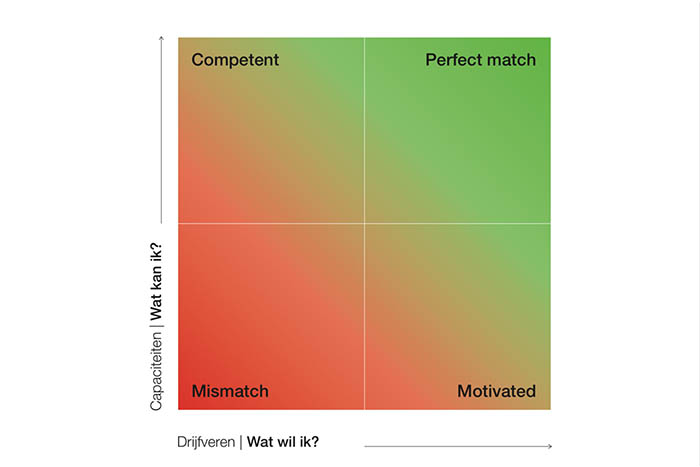
Using seven colours, MyDrives answers the question: what do I want? With those same colours, the MyHabits 360º feedback analysis gives insight into your personal behaviour and answers the question: what do I do? And MyMatch answers the question: what can I do? By combining MyDrives, MyHabits and MyMatch, a more complete picture of the person emerges, and as an individual or an organisation you can make better decisions and genuinely move forward.
Rather experience for yourself what drives you?
Take the free miniscan and discover in a few minutes what moves you.