Two questions are central to the Tuckman model: where do you stand now as a team and where do you want to be? To answer those questions the model uses four stages: forming, storming, norming and performing. In the forming stage a team of employees and a manager have only just come together, and communication largely takes place with the manager, who sets out the line to follow. In the storming stage the employees start seeking each other out a little, but the manager's role is undiminished, because every employee is still looking for their own place within the team. That is why the storming stage is also called the ego stage. In the norming stage employees are open to mutual feedback and the manager's task shifts to a more guiding and advisory role. In the performing stage, finally, the team reaches maturity. The team members make use of each other's strengths in the interest of the team, and the manager's role is only marginal.
Glass ceiling
But suppose that after some time a new employee is added to the team. Or that an employee leaves the team. Then the team lands back in the storming stage, after which it has to find its way up again through the remaining stages. Incidentally, the following applies: the higher the team climbs, the more mutual trust increases. Between the storming and norming stages there is a glass ceiling. Just below this ceiling, alongside trust, openness, engagement, responsibility, respect and understanding have to be established. Because not all team members feel they are in the same stage, it is difficult to break through this glass ceiling. And to determine which style of leadership fits best. Is that people-oriented or task-oriented leadership? The forming and storming stages are the task-oriented stages, in which the team above all needs clarity. The norming and performing stages are characterised by people-oriented leadership. That focus on people comes together in the question: to what extent are the team members willing and able to listen to each other and open to feedback in order to lift the collaboration to a higher level?
The Tuckman model and colour theory
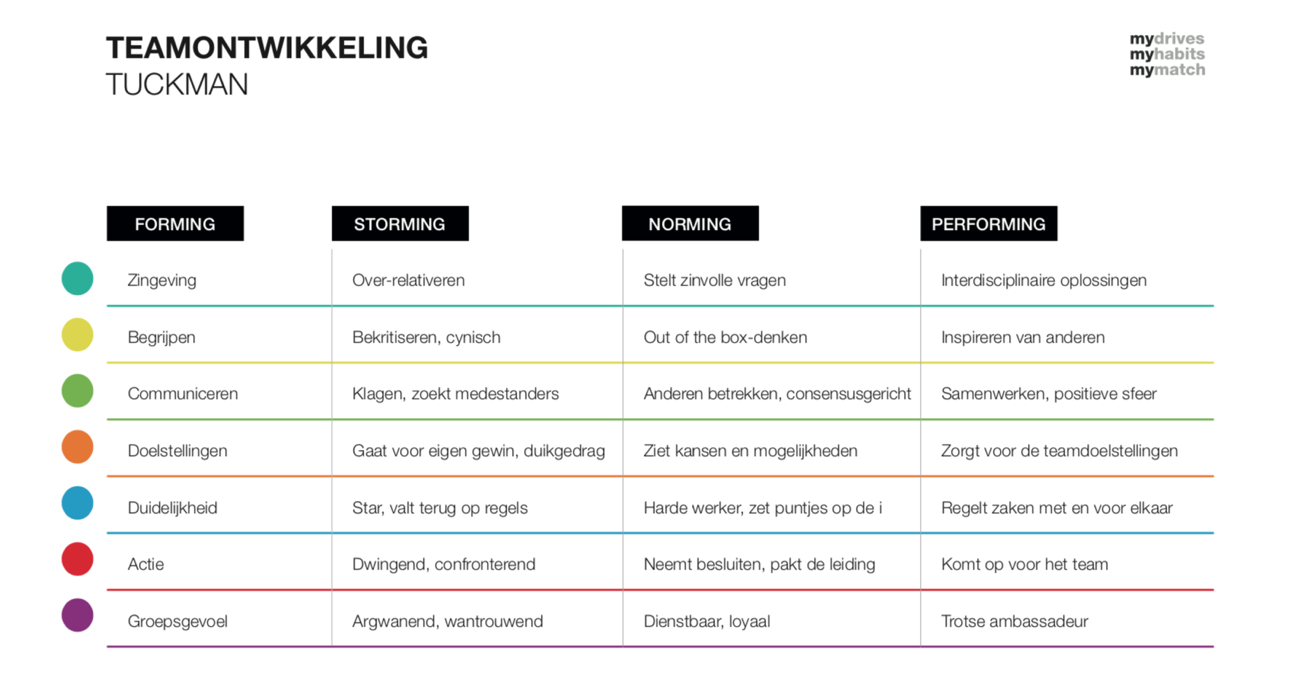
To make the link between the Tuckman model and the seven-colour theory on which MyDrives is based, this is the connecting question: which colour behaviour does a team member display in which Tuckman stage? A ’yellow’ team member, for instance, will quickly be inclined to ask the what and the why questions in the forming stage, and will take a critical and perhaps even cynical position in the storming stage. In the norming stage this team member often stands out by coming up with out-of-the-box ideas. In the performing stage there is a good chance that the ’yellow’ team member will inspire their colleagues. And a ’red’ team member will want to tackle matters straight away in the forming stage, be confronting in the storming stage, be decisive in the norming stage and stand up for the team in the performing stage.
In summary
What it comes down to: in the forming stage it is mainly about the need of a colour (what do I want?). In the storming stage the attention lies on preventing the obstructive behaviour of a colour. During the norming stage team members display the strength of a colour, and in the performing stage they are able to fulfil the ultimate team role from their colour and to put the team's interest first. In short, the better you know which colour behaviour a team member displays, the faster you arrive at outstanding team performance.
Rather experience for yourself what drives you?
Take the free miniscan and discover in a few minutes what moves you.