Blog
On the Tuckman model, the new MyDrives game and selecting the best candidates
8 April 2019
During the annual MyDrives consultants gathering, Marc Stijfs, together with Jos Crijns the founder of MyDrives, MyHabits and MyMatch, once again brings up the example of the British Men's Rowing Eight, one of the subjects at the previous meeting for MyDrives consultants in Thorn. After a few disappointing years, this rowing team took gold at the Olympic Games in Sydney in 2000. That outstanding performance brought the rowers the great success they had been looking for. Conclusion: when performance is easy to measure, whoever delivers the best performance will also be the most successful. That is often the case in sport. But how does it work in business, where not all performance is equally measurable? When can you speak of high-performing, successful teams?
The Tuckman model and colour theory
To answer that question, guest speaker and coach Patrick van Well turns after the introduction to the Tuckman model. The overarching questions when coaching teams are these: where do you stand now as a team and where do you want to be? To that end the Tuckman model uses four stages: forming, storming, norming and performing. Patrick makes the link between the Tuckman model and the seven-colour theory on which MyDrives is based. The connecting question here is: which colour behaviour does a team member display in which Tuckman stage? A ’yellow’ team member, for instance, will quickly be inclined to ask the what and the why questions in the forming stage, and will take a critical and perhaps even cynical position in the storming stage. In the norming stage this team member often stands out by coming up with out-of-the-box ideas. In the performing stage there is a good chance that the ’yellow’ team member will inspire their colleagues. In short: the better you know which colour behaviour a team member displays, the faster you are able to reach the next Tuckman stage as a team.
Characteristics of successful teams and the importance of feedback
Marc then gives his view of the characteristics of successful teams. They have 1) a manager who tunes their leadership style to the different Tuckman stages. That produces 2) positive relationships and a culture of trust. Within this culture 3) team members make use of each other's strengths and 4) team members give each other feedback. The latter is essential for letting a team grow. Take an active attitude and ask for feedback, is Marc's message. If you are able to do that, you take a big step forward straight away, as an individual and as a team. Also regard feedback as, let us say, a gift that helps you further. Something else that plays a part is your personal colour profile. From your own drivers you tend to respond to feedback in a particular way. A ’yellow’ person will quickly exclaim: ’You do not understand me’, ’What you are saying is not right’, and a more green-coloured person will respond from their relational bond: ’After everything I have done for you’. The strength of successful teams lies in their openness to receiving feedback.
New: the MyDrives game
Then it is time for a new addition: the MyDrives game. It consists of a set of round discs, each with a different shape punched out of it. The MyDrives consultants are asked to form groups of four. The group members are blindfolded, after which they have to guess by touch which two of all the shapes are missing from the game. The aim of the game: to take the MyDrives colour theory out of its theoretical framework and gain insight into the way personal drivers determine someone's thinking and acting with one sense fewer. How does communication go then? Who takes the lead? And how does the collaboration go? Answering these questions matters more than finding a solution during the MyDrives game. Marc indicates that this game will soon be available for the workshops the MyDrives consultants run.
Selecting the best candidates
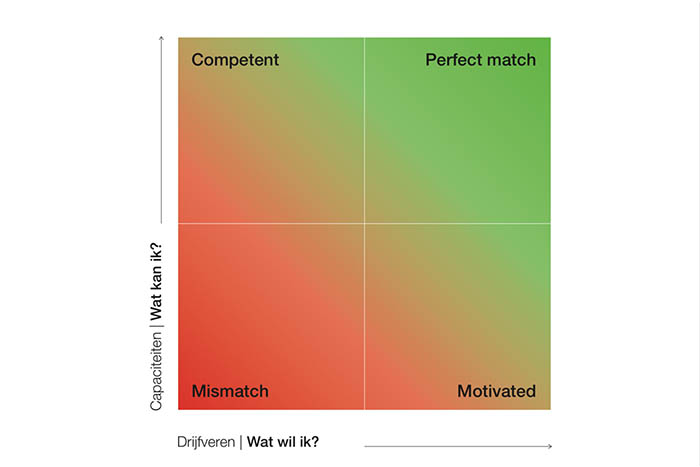
After a discussion with the group, Marc sums up the two most important requirements for selecting the best candidates: find out what someone's drivers are (what do I want?) and what capacities (what can I do?) they possess. Drivers and capacities together form the foundation for being successful in a role. In the coming period the renewed MyMatch module will go online. Once a vacancy has been coloured in with MyMatch, you can add an applicant's MyDrives drivers analyses and aptitude tests to the vacancy concerned in the online environment. The software then gives an indication of the extent to which someone's drivers and capacities match the role.
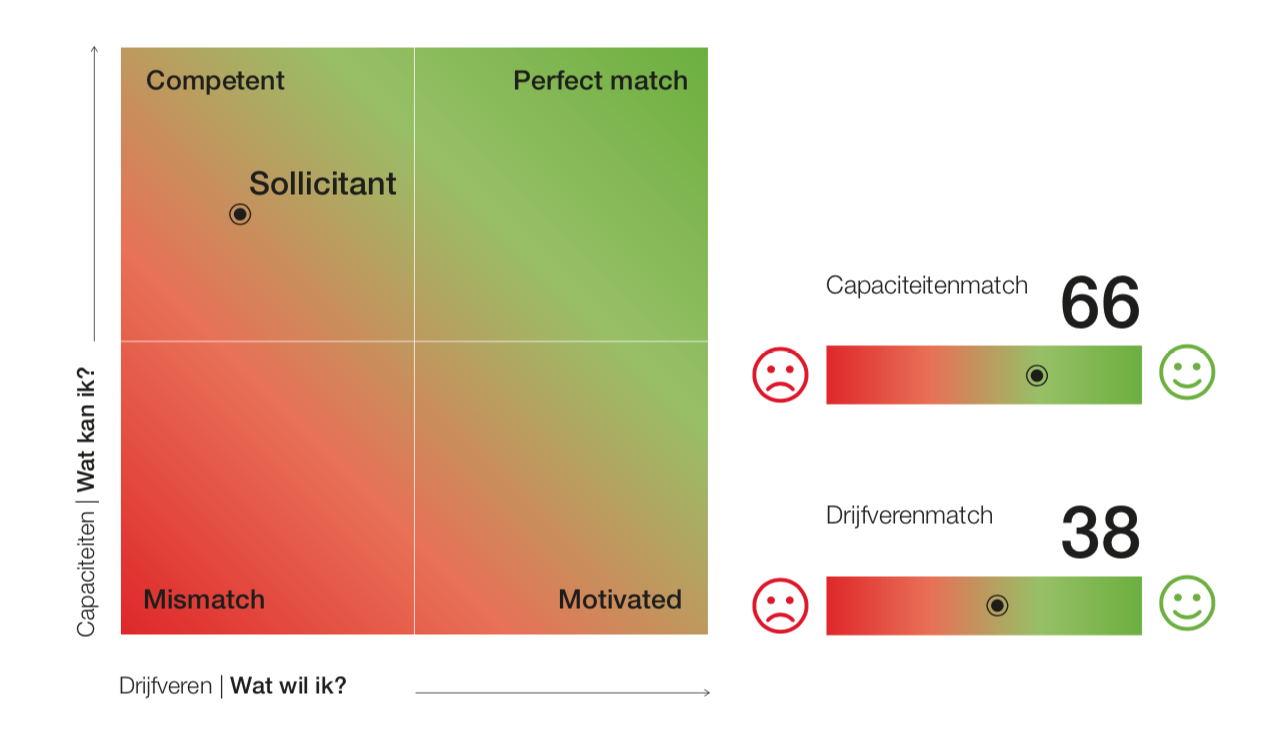
As shown in the diagram above, you quickly get crystal clear insight into whether a candidate is ’competent’ or ’motivated’, or whether you are dealing with a ’mismatch’ or, which is of course the intended aim, with a ’perfect match’.
Rather experience for yourself what drives you?
Take the free miniscan and discover in a few minutes what moves you.
More blog articles
How to select the best job applicants
7 February 2019
Autonomy, mastery and purpose: every employee is the better for it
23 August 2018

MyDrives consultants take a virtual boat trip in Thorn
22 March 2018