
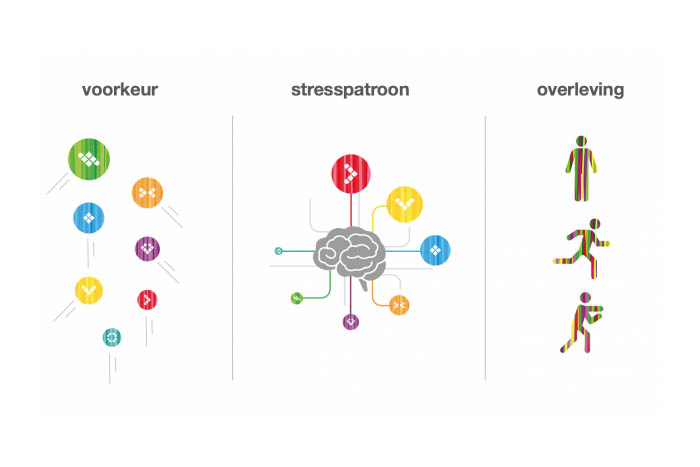
Date: Thursday 16 March 2017. Location: the Hotel Management School in Maastricht. In these natural and relaxed surroundings, around thirty MyDrives consultants from all over the country are present at a MyDrives gathering. The subject is stress. Or, more specifically: how do you as a person respond when you display stress behaviour? With the note that stress arises above all when your own interests are at stake, and the remark that it is difficult in any case to look in the mirror and judge your own behaviour. A personal MyDrives analysis makes your behaviour under high tension clearer, among other things. This is done with an overview showing which of the seven MyDrives driver colours come to the surface in that case. The better you know which colours set the tone in a stressful situation, the more aware you are of your thinking and acting. The positive effect of that: this knowledge puts you in a better position to adjust your response, and you can make personal gains by not letting things come down to a fight, flight or freeze reflex when acute danger threatens in your immediate surroundings. Knowledge of your own behaviour under high tension also frees you from the risk of falling into your own pitfall. An example: in stress-free times you recognise the yellow driver by its fondness for analysing things. Under heavy pressure that analysing gives way to over-analysing, with the result that the yellow driver makes matters unnecessarily complicated. You also make personal gains when you recognise the stress colours of the people around you. You are then not taken by surprise by someone's stress response. That gives you the opportunity to respond quickly and effectively to a hectic situation.
Consistency score
Marc Stijfs, who together with Jos Crijns laid the foundations of MyDrives, MyHabits and MyMatch, opens the gathering and reports that the number of MyDrives analyses carried out has doubled over the past six months. In addition the questionnaire for the MyDrives analysis is now also available in French, Swedish and Italian. It turns out that the great majority of participants in the MyDrives analysis recognise themselves in the result immediately. But it also happens that participants are left with the question: what, is that me? Marc Stijfs points out that some participants may not be feeling their best when they complete the MyDrives questionnaire. Another possibility: someone feels obliged by their manager to complete the questionnaire and does not want to reveal themselves fully. These and other examples can mean that the MyDrives questionnaire is not completed consistently. As a result someone's profile is out of balance and the result is not reliable. The consistency score of each individual participant is these days stated in the analysis report. Marc Stijfs asks the MyDrives consultants present to work together with an ’inconsistent’ participant to find the underlying reason for their inconsistent analysis result. At the end of his introduction Marc Stijfs brings up MyMatch, developed last year. MyMatch uses twenty behavioural types based on the MyDrives colour theory. Which employee do you want as an employer, and the other way round? The answer to that question is central, in the accompanying MyMatch booklet as well, to mapping the perfect match objectively and then putting it into practice.
Heart coherence
Frits Vissers of EagleView is the first guest speaker. As a stress coach, among other things, he focuses in particular on entrepreneurs and managers, working from his personal life motto ’Do what you love or love what you do’. Heart coherence, and the influence of stress on it, is the subject he has chosen for the gathering at the Hotel Management School. He gives a demonstration on the spot by connecting one of those present, via a sensor on the finger, to a HeartMath device that shows on a screen how your heart coherence responds to outside influences. When Frits Vissers directs his attention fully at the test subject in front of everyone, you see sharp peaks and troughs appear in the display of her heart coherence as a result of incipient stress. That is precisely the opposite of what Frits Vissers has in mind: he wants the people he works for to live and work from a state of flow, from a frame of mind that provides continuous physical and mental balance. He shows how you can make a start on that by inviting the test subject to do a heart-focused breathing exercise. To that end he asks her to move her attention to the area around her heart. She then has to imagine her breath flowing freely through her heart and chest area, while at the same time breathing more slowly and more deeply than she normally does. The effect of the exercise translates immediately into the movements on the screen. The sharp peaks and troughs in her heart coherence pattern give way to gentle curves following each other at generous intervals. Frits Vissers emphasises that entering this flow zone has several advantages. Unlike what a stressful situation does to you, you avoid a sudden rise in adrenaline that costs you a lot of energy. The production of destructive and resistance-weakening hormones such as cortisol is prevented. An end is also put to the spread of chaotic signals from the heart to the head. The positive consequences of that in turn: you start thinking more clearly and more creatively, you can take decisions more efficiently and your communication improves. A higher reaction speed and improved body coordination are also advantages connected to the HeartMath method. In summary: as a person you become more vital, healthier and gain more energy. After the demonstration Frits Vissers twice shows a short film in which a taxi drives through a major city. The first time this film is accompanied by calm atmospheric music, the second time by a cacophony of harsh noises. The figurative lesson that becomes clear after the screening: as a person, pay close attention to which music you have playing in your head.
A balanced player selection
You see it a little less than in the past, but still. A good breeding ground for stress is the ice rink, where players take their frustrations out on each other. Theo van Gerwen, technical director of the Dutch Ice Hockey Association, knows all about it. As second guest speaker he says that fights on the ice are no advertisement for the sport. He would rather talk about the MyDrives workshop and the colour theory linked to it at ice hockey club Tilburg Trappers almost a year ago. Among other things, it emerged that the team shows relatively a lot of purple in its profile. Purple being the colour that stands for club feeling, mutual connection, sense of honour and loyalty. Theo van Gerwen does not find that ’purple’ outcome all that striking, knowing that many players come from the club's own academy and have therefore had plenty of time to develop a strong feeling for the club. His attention goes more to the colours yellow and blue. (Yellow standing among other things for creativity and the will to analyse. Blue representing, among other things, strict structure and attention to detail.)
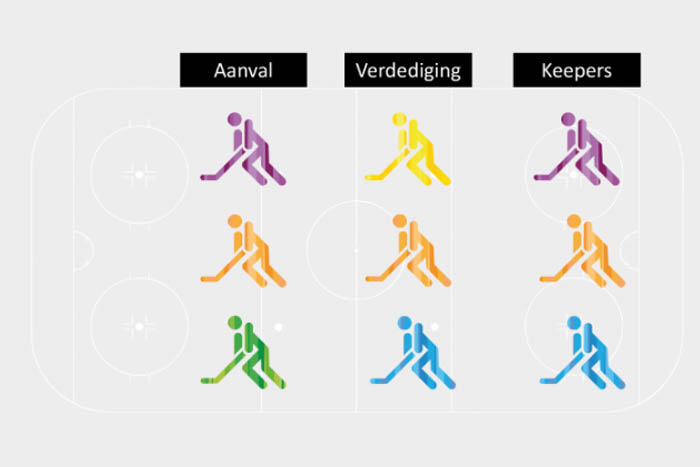
Theo van Gerwen explains that defending players have to possess the colour blue, because a defence simply benefits from a tight structure. Attacking players, by contrast, have to make the difference in goals, and a high degree of creativity is important there in order to pull the opposition's defence apart. The presence of blue is also required in a penalty-kill situation (when you do not have the puck). Yellow is desirable in a power-play situation (when you have plenty of possession of the puck). For these and other reasons MyMatch is an excellent instrument for arriving at a balanced player selection year after year. The stress pattern developed by MyDrives can make an important contribution too, according to Theo van Gerwen. ’When you have insight into the way ice hockey players function under stress, you can make enormous leaps in sporting terms.’
Rather experience for yourself what drives you?
Take the free miniscan and discover in a few minutes what moves you.
More blog articles
How stress leaves me cold-shouldered by myself
1 February 2017

Just go and do what you want
6 October 2016
Case study: MyDrives on the (ice hockey) field
12 September 2016