
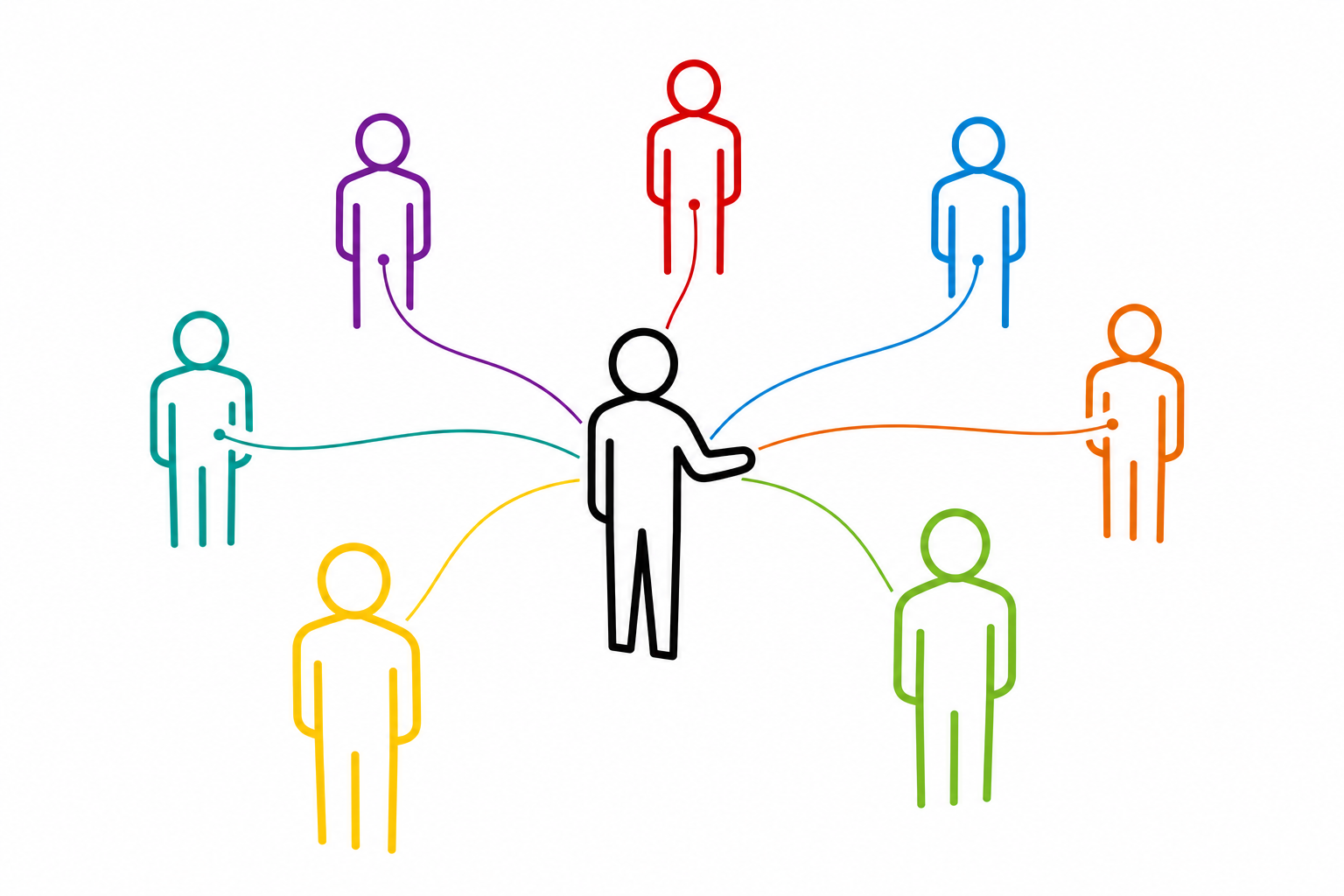
Many leaders think they lead flexibly. Until the pressure rises. Then their own drivers take the wheel.
Your leadership style is often less conscious than you think
A leader with a lot of red wants to move forward. Taking decisions, cutting through issues, picking up the pace. That can be enormously powerful, certainly when a team is stuck or keeps talking for too long.
A leader with a lot of green will sooner look for connection. How is everyone doing? Is there support? Do people feel seen? That is leadership too, just through a different entry point.
In this way every driver has its own natural leadership style. Orange steers on results. Blue on structure and agreements. Yellow on vision and analysis. Purple on safety and loyalty. Turquoise on meaning and the bigger picture.
There is nothing wrong with that. It only becomes tricky when you think your natural style is the right style.
Because then you are no longer leading the other person. You are mainly leading from yourself.
The other person is not automatically moved by what drives you
Anyone with a strong red driver may think that clear pressure helps. "Come on, just do it." For someone who also has a lot of red or orange that can work perfectly well. It gives energy, direction and speed.
But apply that same pressure to someone with a strong green driver, and something else happens. That person may disengage because the connection is missing. Not because they do not want to perform, but because they first want to feel that it is right together.
You see the same with yellow and blue. An employee with a strong yellow driver gains energy from space, thinking, seeing connections and exploring new possibilities. A leader with a strong blue driver who ties everything down in advance may mean well, but removes precisely the air that yellow draws energy from.
That is the heart of leadership with drivers: your preferred style is not automatically the entry point for the other person.
The question is therefore not: "How do I like to lead?"
The better question is: "Which driver do I have to address in this person to create movement?"
Real flexibility is not denying yourself
Flexible leadership does not mean you have to suppress your own drivers. That does not work. Your highest drivers always remain in play. Certainly under pressure.
It does mean learning to see when your automatic style does not fit what the other person needs.
A leader with a strong red driver does not have to lose their decisiveness. But they sometimes have to slow down first, listen and create safety before asking for pace.
A leader with a strong green driver does not have to let go of their focus on people. But they do sometimes have to be clearer, choose more sharply and dare to allow tension.
That is the mature form of leadership: not being stuck to your favourite colour, but consciously choosing behaviour that fits the situation and the person in front of you.
The connection often lies in the highest driver
If you really want to get someone moving, do not look only at role, behaviour or competencies. Look at what someone considers important on the inside.
With someone who has a strong orange driver it often works to make clear what it will yield. What is the goal? Where is the gain? When is it a success?
With someone who has a strong green driver, movement more often starts with relationship and trust. Is there room to think along? Is anyone listening? Is it right for the group?
With someone who has a strong blue driver, clarity helps. What has been agreed? What are the steps? When is it good enough?
With someone who has a strong yellow driver, room for insight works. Why are we doing this? What options are there? What can we learn from it?
The mistake many leaders make is that they address everyone through their own highest driver. That feels logical, but mostly it is simply easy.
Leadership becomes stronger when you learn to switch to the other person's entry point.
A practical check for yourself
In your next conversation, try looking first not at what you want to say, but at which entry point the other person needs.
- Which driver seems to be most in the foreground with this person?
- Am I addressing that driver, or mainly my own preference?
- What behaviour do I have to display in order to connect better?
Sometimes that means picking up the pace. Sometimes slowing down. Sometimes setting clearer boundaries. Sometimes listening first. Sometimes sketching the bigger picture before moving to action.
That is not a trick. That is leadership.
Not because you have to have all colours equally strongly, but because you have enough self-insight not to be governed by a single colour.
Leadership is switching without losing yourself
Your drivers do not disappear the moment you become a manager. They actually become more visible. In how you take decisions, give feedback, apply pressure, build trust and deal with resistance.
That is why leadership does not start with a model, but with honest self-insight.
What is my automatic colour?
When does it help?
When does it get in my way?
And which driver do I have to address in the other person to create real movement?
The leader who can do that does not have one fixed style. That leader can switch.
And that is precisely where connection arises.
Rather experience for yourself what drives you?
Take the free miniscan and discover in a few minutes what moves you.
More blog articles
What is a drivers assessment?
18 June 2026
The promotion paradox
20 May 2026
Competent but not motivated
22 April 2026