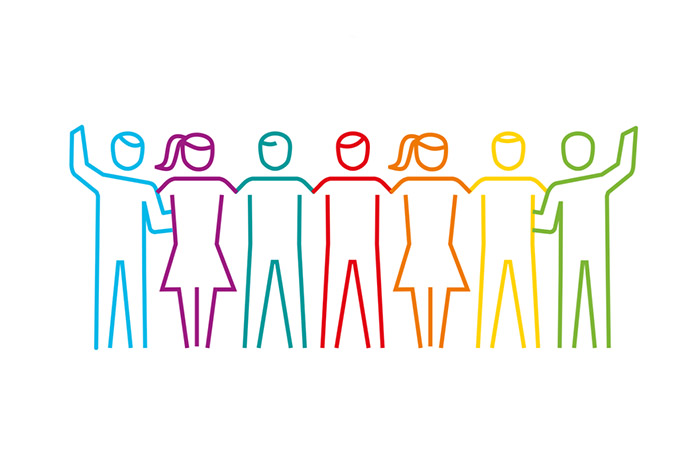
Ask any random person what a colleague is. Nine times out of ten you will be told it is someone you work for the same company with. The emphasis in that case is on working alongside each other rather than on genuinely working together. Yet the latter is very much the point once you know that the word ’colleague’ derives from the Latin verb ’colligere’. ’Co’ stands for ’together’ and the full verb for ’to bring together’.
Getting into someone's skin, not under it
But how do you actually bring colleagues with different personalities together within a team? The shared seven-colour language of MyDrives was developed in part to give the word ’colleague’ its original meaning back. On the basis of that language you quickly gain insight into what drives you, and you find out just as quickly how the people around you are put together. That knowledge opens the way to making positive use of one another's drivers. Because you are then able to get into someone's skin instead of constantly getting under each other's. The result is that you communicate and collaborate more effectively and more efficiently in order to reach team goals. At the same time, strong mutual connection delivers this welcome bonus: you enjoy your work considerably more.
Examples
A few examples, without spelling out the seven-colour language in full. ’Red’ employees in a team act quickly and directly, while ’yellow’ employees first ask critical questions and want to analyse matters before moving to action. ’Blue’ employees value structure and clear agreements above all. That is simply their nature. ’Green’ employees, by contrast, consider it more important that all team members are involved in carrying out an assignment in a harmonious way.
Avoid overly one-sided teams
Reading the above, you might think: just build teams made up of employees who all share the same dominant driver colour. That saves a lot of work, surely? Such teams do exist, particularly in departments where employees hold the same role. Only: that can bring risks with it. Groupthink is one of them, with team members adopting each other's ideas uncritically. And that in turn can lead to tunnel vision. You also run the risk that certain talents remain unused. Suppose a team consists exclusively of naturally performance-oriented ’orange’ employees. Then the social, creative, analytical and other valuable skills of other employees get buried. For these reasons among others, it is better to avoid putting together overly one-sided teams.
The kite and the headwind
In summary it comes down to this: there is nothing wrong with teams sharing a common driver to a reasonable degree. As long as you make sure that all team members can retain and express their own personality. Because it is the headwind that makes the kite rise. Just as the seven-colour language of MyDrives has for years made a proven contribution to helping all kinds of teams fly even higher.
Rather experience for yourself what drives you?
Take the free miniscan and discover in a few minutes what moves you.
More blog articles
What colour will the White House be?
1 November 2024
A panda does not bark and a personality does not bluff
1 October 2024
Discover how you react under high pressure
10 September 2024